Showing posts with label new covenant. Show all posts

Sunday, March 22, 2009

a new covenant . . . and why does this matter?


Jer. 31:31-34
For Sunday, March 29, 2009
Fifth Sunday in Lent

'Covenant' is not a word you are likely to hear discussed on the Sunday morning talk shows. The concerns of our contemporary world are more around words like 'economy', 'terror', 'environment', or 'health care'. Yet for God, clearly the concern of 'covenant' is central. What does it mean? Why does it matter so much for God? ... And should it mean anything for us? If so, what?

A 'Covenant' is something which binds two parties together. For example, the marriage covenant binds husband to wife. Through the prophet Jeremiah God says, "The time is coming when I will make a new covenant with the house of Israel." In other words, God is putting into place a new agreement binding Him to his people. How would this binding agreement be different than the one He made initially?

A 'Covenant' is something which binds two parties together. For example, a marriage covenant binds husband to wife. Through the prophet Jeremiah God says, "The time is coming when I will make a new covenant with the house of Israel." In other words, God is putting into place a new agreement binding Him to his people. How would this binding agreement be different than the one He made initially? It would be different in that rather than writing his law on tablets of stone God would now be writing his law on the very hearts and minds of his people. Where his people had failed to keep the Old Covenant, they could not fail to keep the New Covenant, because it would be written into their very beings.

Christians, as people of God under this New Covenant, therefore cannot fail. "Wait a minute," you might respond, "I'm a Christian, and I fail all the time, and certainly most if not all the Christians I've ever met have the same problem." Let's be careful here to remember the kind of failure that God has in mind, namely, the breaking of that which binds God to his people. The key difference between the Old and New Covenant is that while the Old contained within it conditions for the bound people to fulfill, the New Covenant has none of these. Everything is on God's side of the ledger.

Here then is the so what. First, if you really are a Christian, enjoy the security of God's binding commitment to you. Yes, you will fail morally, spiritually, personally. Yet you cannot fail in terms of the covenant, because God has bound you to Him. Therefore, give him all of your life that you might bring glory to His marvelous name. You don't have to be perfect: you just have to be moving in the direction of God's glory.

So why then is 'covenant' such an important idea to God? It's because he is all about relationship. We actually understand this without realizing it. For us, what is more important then our relationships with mother, father, brother, sister, best friend? Ultimately, very little if anything.

What then if we made what is most important to God most important to us? What if we lived in a way that reflected our desire to honor the covenant God has made unconditionally with us?
I have so committed myself today. It's tremendously freeing, empowering, and peaceful. Care to join me? He loves you. He's here for us. Praise the Lord.

Monday, October 08, 2007

the time has come

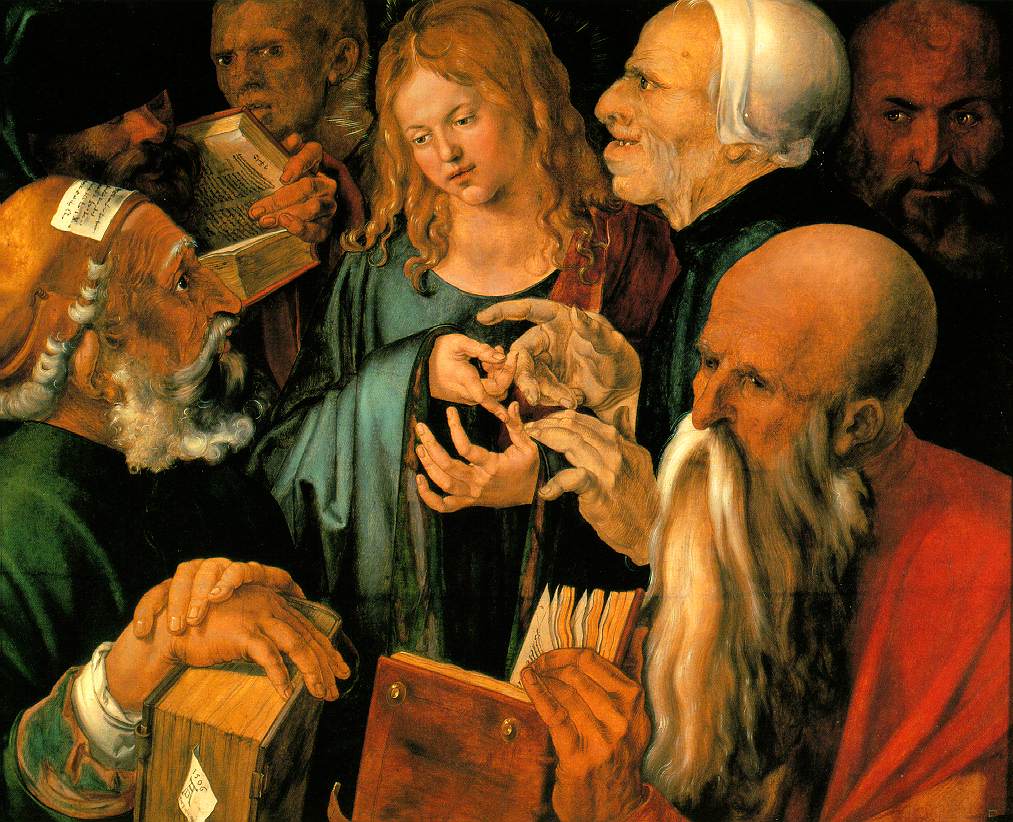
Albrecht Dürer, "Christ Among the Doctors"
1506 (150 kB); Oil on panel, 65 x 80 cm; Fundacion Coleccion Thyssen-Bornemisza, Madrid

Jeremiah 31:27-34
For Sunday, October 21, 2007 (Proper 24)

"The time is coming... " These are some of the most electric words of the Old Testament: “The time is coming when I will make a new covenant with the House of Israel and the House of Judah.” Here are three key questions important for understanding what Jeremiah is talking about:
  • What ‘time’ is he referring to?
  • What is a ‘covenant’?
  • What do the Houses of Israel and Judah represent?

One great way to answer questions like this is to read from a Bible that has cross-references. I personally like the Broadman-Holman NIV thinline Bible, because it provides these cross-references in a good contemporary English translation while still being portable.

Regarding the first question then, cross references show that Jer. 31 is quoted in Hebrews chapter 8. Hebrews is a fantastic book. It scares Christians away because it is very Jewish and contains a lot of theology. But given reasonable consideration it can be a become a personal tour guide for understanding what the Old Testament really means. Hebrews 8 makes clear that the ‘time’ Jeremiah is referring to in Jer. 31 is none other than the coming of Christ. Heb 8:7 makes this explicit in referring to the “ministry of Jesus”.

The second question then is what Jeremiah means by a ‘covenant’. A ‘covenant’ means a treaty, a pledge, an alliance of friendship, a pledge, or a constitution. In this case it a pledge of God’s commitment to an alliance of friendship with his people. The old covenant was the one God made to Abraham to bless all the peoples of the earth through him. The problem with the old covenant was that while God kept his end of the bargain, his people, did not keep up their end of the bargain. They were now divided into the separate Houses of Israel (the northern kingdom) and Judah (the southern kingdom). Both were in breach of contract, which is why the northern kingdom no longer existed and why the southern kingdom presently found itself in exile.

Now, here’s the rub (in answer to the third question above): wasn’t Jesus' covenant for the church as opposed to being for the Jewish people? Yes and no. Yes, the new covenant was for the church but it was intended also for the Jewish people. The new covenant was always meant for the entire people of God, both Jew and non-Jew (Gentile). The author of Hebrews makes this clear as he carries his reflection on Jeremiah right through to Hebrews chapter 12, 22,23:

But you have come to Mount Zion, to the heavenly Jerusalem, the city of the living God. You have come to thousands upon thousands of angels in joyful assembly, to the church of the firstborn, whose names are written in heaven.

There are angels singing with joy in heaven this very day because of the many people whose lives are written in the book of life in heaven. The time therefore is not still coming: it has come already! This is a clarion call to live fully committed lives that proclaim the grace and glory of the gospel with everything we say and do.