Wednesday, February 25, 2009

biblical Greek reading club


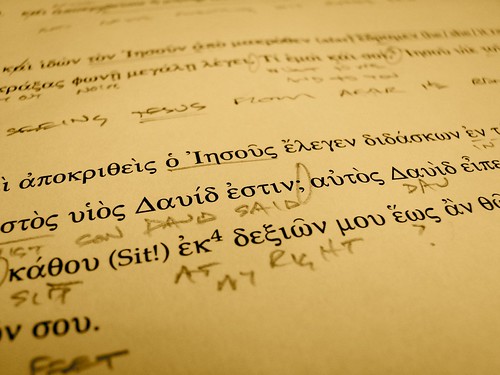
A couple of years ago two downtown Milwaukee business colleagues and I began to meet each week over lunch to read the Bible in Greek. Because I am now working in Franklin, WI as opposed to downtown Milwaukee, we've now taken our weekly meeting to Sunday nights, 8:00 pm Central Daylight Time on the internet by Skype. Would any of you like to join us? If so, please contact me with your Skype username and we'll conference you in.

The pre-requisite is a first year class in Greek. We're finding the fellowship, intellectual, and spiritual challenge to be profound. We're currently working our way through James chapter 3. Usually we spend some time parsing sentences, then coming to grips with the grammar, and then the practical implications of what we've read and discussed.

Why go to the time and trouble of reading the Bible in Greek? My answer is why go to the time and trouble of visiting the Grand Canyon. It's one thing to see it in a picture but quite another to walk in the dimensions of its shadows. The Biblical languages are doorways into the terrain of the divine.

You are welcome to join us on our next adventure.

stimulus for the soul

In 2004 I had the honor of being among the first class of Centurions, a 1-year mentoring program in Christian worldview sponsored by Chuck Colson and PFM (what used to be called Prison Fellowship before the marketing folks got a hold of it). The time with Chuck and his teaching staff was profound, and I continue to this day to benefit from being a member of this extended community. One of Chuck's teacher, who has become a mentor for me, as well as for him, is T.M. Moore. One of T.M.'s ministries is to write a weekly devotional for the Centurion community. This week's devotional was profound in terms of its diagnosis of our nation's present ills and the way out of the malaise. Here it is:
Vol. 2, No. 49
19 February 2009

This method’s no madness!

In Psalm 12 David decried the preponderance of lies, half-truths, and deceit that characterized his day. The Lie, in fact, had all but driven the Godly folk underground, while evil men boasted about their prowess, autonomy, and ability to do whatever they planned. All that was good – everything which had its origins among the people of God – was being stolen and trashed by the promulgators of the Lie, and the people of God, poor and groaning, cried out to the Lord for relief. In response to their fervent pleas, God decided to rise up and deliver them. But His program of deliverance for a people up to their eyeteeth in lies is not political; instead, God pledged to deliver His people from the oppression of the Lie by taking them back to His Word (vv. 5, 6).

The Word, God reminded them, is pure and faultless (v. 6). God has spoken His Word, and He will carry it out (v. 7). By His precious and very great promises He will guard and shield His people (v. 7), but they must take refuge in that Word, so that they can sort out the Truth from the Lie and stay the course of obedience to the Lord. The wicked and vile may stalk and prowl and strut about on every side, but the Word of God will keep and protect all who submit to its teaching.

Festus thought the Apostle Paul mad because he appealed to the Word of the Lord in his defense (Acts 26.19-29). Doubtless today many would consider us naïve, uneducated, and certainly unsophisticated if we began to insist that the release from woe and uncertainty that this nation sorely needs will not be found in government bailouts but in the revelation of God in Scripture. So desperate are Americans becoming, as job losses and foreclosures and the rolls of the unemployed continue to rise, that they are willing to accept just about any scheme that promises to preserve their wellbeing against the encroaching evil of economic collapse. To call them to seek the wisdom and will of God in Scripture will undoubtedly expose us to mountains of scorn and opprobrium.

Nevertheless, only the Word of God can light the path to order, security, and prosperity. In troubled times – as at all times – the Christian submits his or her mind to the Word of God, and from behind that pure and unchanging visor, looks out on the world of sin and the fears and needs of our neighbors. The problems facing this nation are not, in the first place, economic or political. It’s not a question of how many billions will be necessary to prop up the economy, or which side of the isle has the best program to shore up our future. The economic and political frenzy in which we are currently embroiled is merely a reflection of the turmoil, uncertainty, wickedness, fear, and ignorance in the souls of our countrymen. Yet we are a nation in which over 90% of our citizens profess to believe in God and some 40% claim to have a born-again relationship with Him. How can we be so insistent on the reality of God and certain of our status in relationship to Him, and at the same time – as certainly seems to be the case – so utterly ignorant and untrusting of His Word?

It’s because we have not sheltered in the Word with respect to the everyday realities of our lives. That is, we have not developed a Biblical way of thinking and living in the practical, day-to-day activities, roles, and relationships that make up our normal routines. We love the Word and fervently embrace it while we’re at church or discussing with one another in our Bible study groups. But when it comes to applying the teaching of Scripture to the economic, moral, social, political, vocational, and cultural activities of our lives, we don’t know where to begin. This is why Biblical worldview matters so much, why it is so important that a generation arise who are resolved to immerse their minds and lives in the Scriptures, to cling to every Word of God as reliable and true altogether, and to prove the faithfulness and power of Scripture by daily obedience in every area of life and interest.

God has raised up the Centurions to help spawn that new generation, that movement of people who live in the shelter of the Truth and fight against the Lie in every conversation, relationship, and activity of their lives.

For reflection and action

“I will place him in the safety for which he longs.” Psalm 12:5

Do we long for the safety of God’s Word?

T. M.
Reprinted with permission. T. M. Moore, Copyright 2009 BreakPoint / PFM.

Noah's flood: All truth is God's truth

Savrasov, "The Rainbow" (1875)

Gen. 9:8-17

For Sunday, March 1, 2009
First Sunday of Lent

In this chapter God says to Noah, "I now establish my covenant with you . . . Never again will all life be cut off by the waters of a flood . . . This is the sign of the covenant I am making between me and you . . . I have set my rainbow in the clouds, and it will be the sign of the covenant between me and the earth."

Is this credible from a historical and scientific perspective? The question is important, because it would mean first that the Bible speaks to all of life, and second that the reality is that we are not merely chance products of Darwinian evolution.

The irony is that not all Christians agree. Some believe that Noah's flood was regional in extent, while others believe it literally covered the whole earth. Resolving this disagreement is not important here. What is important is to challenge each of us to put together a coherent worldview that best accounts for the evidence from theology, history, and science.

One important point to remember is that facts are not self-interpreting. Rather, facts are interpreted within the framework of a worldview. The worldview from which one starts will help to determine which facts are relevant or even noticed, and what they mean.

Is the earth young or old? What does the Bible really suggest? What scientific evidence is there on either side? Could Noah's flood and Noah's ark really have happened? How sad that these questions so often don't get asked either in public schools or in the church.

One place to start for answers is the website "Reasons to Believe". This particular site takes the position that the earth is old and that both Creation and Noah's Flood are real. Another interesting place to begin one's thinking is the Wikipedia article on flood geology.

The important and exciting thing to me, even though there are different interpretive options available, is that there is overwhelming evidence that the Bible speaks credibly and truthfully to all of life. Maybe if we spent more time putting our worldviews together our lives would begin to come together as well.

Wednesday, February 18, 2009

Transfiguration Sunday

Bellini, "Transfiguration of the Christ"

2 Kings 2:1-12

For Sunday, February 22, 2009

Transfiguration Sunday


This coming Sunday is Transfiguration Sunday, the last Sunday before Lent begins. The purpose of Transfiguration Sunday is to prepare the church for the rigors of Lent by focusing attention on the holiness of Jesus Christ as revealed in his transfiguration. Lent is the forty day period prior to Easter Sunday when the church focuses on the sufferings of Jesus. Lent is a journey to the cross and then past the cross to an empty tomb.

When I was a kid I always thought Lent was a little strange. It sounded so much like lint. At the same time, my parents seemed to think it was a time to get one's spiritual lint out.

Where does the name 'Lent' come from? The short answer is that it was a lot easier to say than the alternatives. As Wikipedia notes:

In the English language, Lent was formerly referred to by the Latin term quadragesima (translation of the original Greek tessarakoste, the "fortieth day" before Easter). This nomenclature is preserved in Romance, Slavic and Celtic languages (for example, Spanish cuaresma, Portuguese quaresma, French carême, Italian quaresima, Croatian korizma, Irish Carghas, and Welsh C(a)rawys).

In the late Middle Ages, as sermons began to be given in the vernacular instead of Latin, the English word lent was adopted. This word initially simply meant spring and derives from the Germanic root for long because in the spring the days visibly lengthen.

With this bit of lint out of the way, let's return to Transfiguration Sunday. It is fitting that the first reading for Transfiguration Sunday should feature Elijah, for he along with Moses appeared next to Jesus at the Transfiguration.

There is a thread of God's redemptive purpose that runs from Moses through Elijah and on to Jesus. First, there are many similarities between Moses and Elijah (Expositor's Bible Commentary). Both men received revelations from God on Mt. Horeb. Both crossed a body of water from west to east (Moses the Red Sea and Elijah the Jordan. Both exercised profound leadership that was then inherited by worthy subordinates (Joshua and Elisha). Both had lives that ended on earth in mysterious circumstances. H. H. Rowley said, “Without Moses the religion of Yahweh . . . would never have been born. Without Elijah it would have died.”

There is then a clear connection between Elijah and Jesus. The Prophet Malachi predicted that Elijah would return before the great and terrible day of the Lord. Jesus then completed the link by indicating that the ministry of John the Baptist fulfilled Malachi’s prophecy.

One take away for me is to follow the example of Elisha, who also appears in this chapter. Elisha found a man of God, and followed him, to the point of refusing to leave. As an aspiring man of God, I am acutely aware of my need for greater men to serve as models of the faith.

Thursday, February 12, 2009

triumph of the ruling class

I highly recommend reading yesterday's Breakpoint Column by Chuck Colson entitled, "Where Government Doesn't Belong: Triumph of the Ruling Class." The column insightfully links Tom Daschle's tax problem to a liberal ideology embraced by many in both parties that is responsible for a massive transfer of wealth and power from the private sector to the public one. Colson rightly critiques this liberal ideology based on the key Reformation principle of "sphere sovereignty" - the idea that the authority of given entities (like the government) extends through one sphere of life, but not through all spheres of life. As Chuck says, we citizens of the United States ought not, in a panic, cede our sovereignty to a governing class "all to willing to accept our acquiescence."