Now that I've tried this for awhile I need a little time to step back and evaluate whether this is really the best investment of my limited time to write. I anticipate having an update on this by Sept. 9th.
Yesterday's Breakpoint commentary by Chuck Colson is a fascinating glimpse into the current life of filmmaker and intellectual Woody Allen as well as questions of priority and purpose:
http://www.breakpoint.org/listingarticle.asp?ID=487
Saturday, August 26, 2006


Saturday, August 12, 2006
an invitation to wisdom
 Paolo Veronese, Allegory of Wisdom and Strength c. 1580;
 Oil on canvas, 214.6 x 167 cm; Frick Collection, New York
Proper 15
Proverbs 9:1-6
"Wisdom has built her house," and we're all invited to come live there. Yet this means "leaving our simple ways" and "walking in the way of understanding."
As Christian author and former missionary Elizabeth Elliot once put it, "What do you live for? How do you get it? Is it worth it?"
On my morning commute I like to look at other cars to dream just for a moment about what might replace my '96 Accord with the dented hood, cracked bumper, and rusting rear wheel wells. Some of the cars that have caught my eye are a Porsche Carerra, a BMW 3 series, an Audi TT (or something like that), and a Mercedes 2-door.
Yet is this where I really want my attentiont to be focused? Going even further, do I want to structure my life around maximizing my personal income? No way. There are much more important things in life. Wisdom says, "Listen to your heart. Pursue your dreams. Nurture your family."
This is not to say that a nicer car might not be an appropriate part of the overall picture but God forbid that I should live just for that. What is worth living for is seeing my wife grow and thrive, and seeing my three boys grow into the men God intends them to be.
Father, how we need wisdom, and what a privilege it is to be invited into your house and welcomed at your table.
Thursday, August 10, 2006
dangerous times
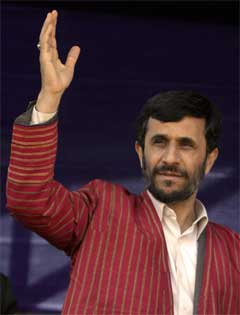 Iranian President Amadinejad
Recent World Events
Two recent events in the news have caught my attention. First, a couple of days ago Bernard Lewis, a Middle East expert, wrote in the Wall Street Journal about the seriousness of Iranian President Amadinejad's threat to wipe Israel off the face of the earth. Amadinejad stated that on August 22nd, one of Shiite Islam's most holy days, the world would hear Iran's response to the United Nation's demand that Iran dismantle its nuclear program.
If the August 22nd threat is credible, what will Israel do? Will they wait to find out whether Iran will detonate a nuke over Tel Aviv? Or will they attack Iran pre-emptively? This presents a real and present threat of nuclear war.
The second event was today's news about the foiled terror plot in England. I'll never look at a contact lense case the same.
All joking aside, both of these citations are further evidence of a clash of civilizations between the West and Islam. How vital it is for the West to understand its roots in the Judeo-Christian tradition, and how those roots are grounded in the truth of how the world actually is, in all its grandeur and fallenness.
A secular West will not likely survive the onslaught. Only those with faith in a greater hope will be able to respond to the darker side of Islam. As Jesus said, "You will know the truth, and the truth will set you free."
In view of all of this, how important for all of us to sharpen ourselves that we might be used for God's purposes. What the world needs now is people with clear thinking, grace, peace, and resolve.
Saturday, August 05, 2006
truthfulness and anger
 Proper 14
Eph. 4:25-5:2
As mentioned earlier, we are not to fake it in church. This means first and foremost "speaking truthfully" to our fellow believers.
Yet there is an important corollary to this: "in your anger, do not sin." If one reads this verse on its own, it might seem the point is not to express one's anger, but actually the point is not to suppress one's anger. This is why Paul says, "Do not let the sun go down while you are still angry."
There are two ways one might try to avoid the sun going down on one's anger. One is to work diligently to convince oneself, "I'm not still angry with that person." The other, which is much more effective, is to act appropriately on the anger, which is in actual fact divine energy for change, by communicating with the person that made you angry in a constructive way. This is "speaking truthfully" (v. 25).
Suppressing anger can do great damage to yourself and to a relationship you treasure. You can tell yourself you aren't angry, but you are, and the relationship with that person will be slowly eroded away if you continue down this path. It's not worth it. Take a chance: go and speak the truth in love. In so doing, you may just find kindness, compassion, and forgiveness (4:32).
why the desert redux

Proper 14
Deuteronomy 8:1-11
Once again, why the desert? Moses himself answers this question: "To humble you and to test you in order to know what was in your heart, whether or not you would keep his commands. He humbled you, causing you to hunger and then feeding you with manna . . . to teach you that man does not live on bread alone but on every word that comes from the mouth of the Lord." Jesus certainly understood this when contending with the devil during his own desert experience.
Despite the deserts through which we journey we can be confident in this: "The Lord your God is bringing you into a good land." It is a place where bread will not be scarce and we will lack nothing.
Already, having journeyed as the people of God from the promised land of Israel to the promise of the gospel, we are closer still to the good land of heaven. In response, let's praise him today with our words and our lives.
the bread of life: what's the point?

Proper 14 - John 6:37, 41-51
The key verse in this paragraph is the last one: “I am the living bread . . . If anyone eats of this bread he will live forever. This bread is my flesh, which I will give for the life of the world.”
Now what did Jesus really have in mind here? The Jews wanted to understand him literally: “How can this man give us his flesh to eat?” But this wasn’t really the point. The bread was a metaphor to help explain a spiritual reality in earthly terms. Just as Man needs bread to nourish him for a day, so does Man need Jesus to nourish him for eternity. The point is not that we need to eat Jesus on a weekly basis, but rather that we need to believe with the kind of commitment that is manifest in the commitment we make to ingesting a piece of bread.
Wednesday, August 02, 2006
good press for Christian devotion
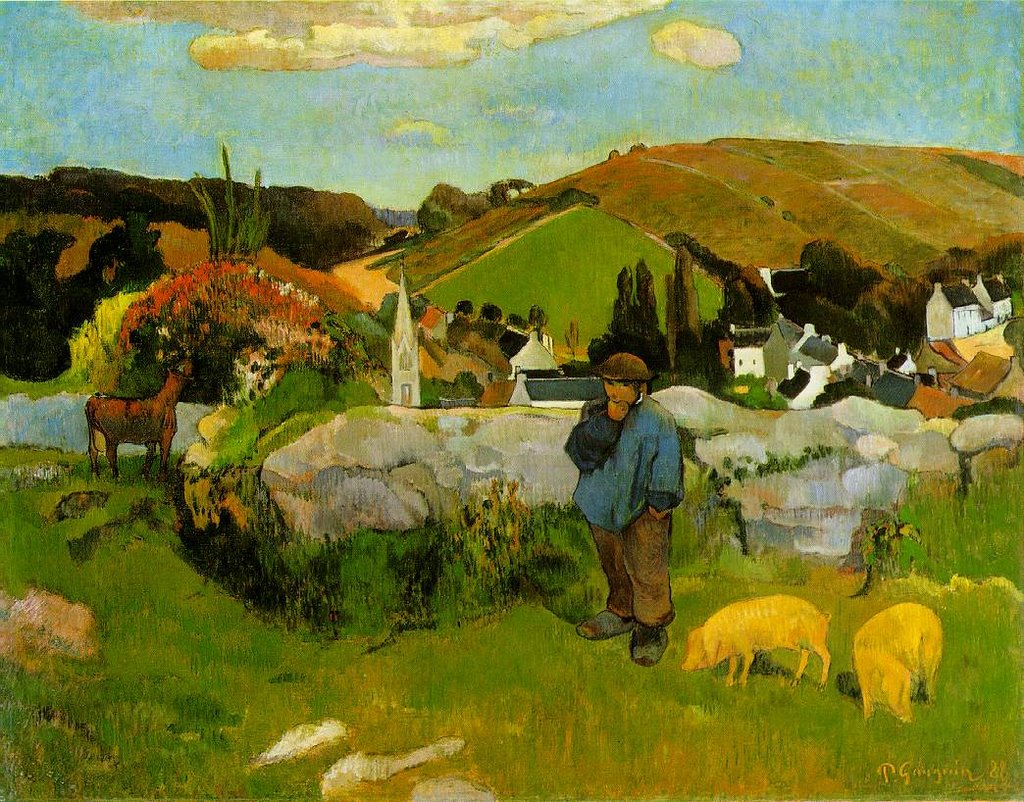 Gauguin, "Swineherd"
 Proper 14 - Psalm 34
Christian devotion does not get a lot of good press these days. This Psalm provides a number of reasons why it should. A personal commitment to Christ gives hope to the afflicted; gives the soul the object of affection it longs for deeply; delivers people from fears both real and imagined; makes radiant the faces of its followers; frees people from shame whether real or imposed; delivers people from poverty and trouble; provides spiritual protection and empowerment, as well as blessing and refuge.
Consider for example the experience of my missionary colleague, who was leaving Hungary after a number of years working there while the country was still within the Soviet orbit. As he was crossing the border checkpoint, a border guard said to him, “You are leaving? I’m always sad when the believers go.” “How did you know I was a believer?” my colleague inquired. “Oh, I know all the believers,” the guard replied, “I know them by the light in their eyes.” Those who look to him are radiant; their faces are never covered with shame (v. 5).
If you haven’t yet committed yourself to Christ may this Psalm nudge you into the family. If you have already committed to Christ, but are compromising, may these words draw you back to the fidelity of full devotion.
You are deeply loved and fully empowered in the grace of Christ.
Subscribe to:
Posts (Atom)