Thursday, June 22, 2006

Quiet! Be still (Mark 4:35-41)

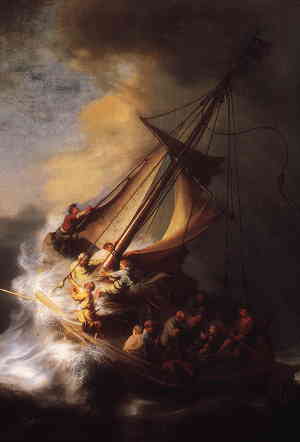
Ian Pollock, "Tempest Stilled"

My previous post includes Rembrandt's "Storm on the Sea of Galilee". This work was stolen in 1990 and is now on the FBI's top ten art thefts list: http://www.fbi.gov/hq/cid/arttheft/topten/isabella.htm.
Today's image may reflect an artist suffering from lower back pain. A sympathetic reading might however be that Jesus is indeed Lord of creation as well as Lord of our lives. His ability to calm the storm on the Sea of Galilee was a foreshadowing of his ability to calm the storm of sin that was unleashed with the mere crunch of a piece of forbidden fruit. Creation is majestic, sin is serious, and our Father's power to reconcile is undeniable.

Mark chapter 4 is so rich: the parable of the sower, a lamp on a stand, a growing seed, a mustard seed, and now Jesus calming the storm. Having lived along the shores of Lake Michigan here in Wisconsin, as well as along the shores of Lake Baikal in Siberia, I understand the potential ferocity of squalls on inland bodies of water such as the Sea of Galilee.
"Don't you care if we drown?" The disciples would not the be the last to put such a question to Jesus. I've been facing a storm of my own the last four years made up of numerous elements: a spouses health problems, a loss of two ministries, a father's strokes, a mother's mental illness, a brother's cancer, and a change of vocation. There have been times when I've cried out, "Lord, don't you care?"
We read this story and think, "How thick-headed those disciples were. They are with Jesus personally, and a little squall comes up, and they lose it." Thick-headed indeed. That anyone who is with Jesus would lose it in this way...
So is there an alternative to falling apart when the storms of life rage? "Why are you so afraid? Do you still have no faith?" There is the key: F-A-I-T-H. Faith the size of a mustard seed will suffice.
Take my case. Yes, there have been significant losses. No, it still doesn't all make sense. But can I trust and obey? Can I find peace and joy in today? Yes! Jesus is standing right here with me in this little dingy of life saying, "Quiet! Be still."
More of it may make sense through the eyes of faith. Had the Lord not brought my family back from Russia four years ago my boys would not have had four precious years with Grandpa before his death. I would not have been in a position to assume the role of patriarch for my extended family. The Russian-led ministry which has emerged from the fertile soil of a volcanic blast of expatriate missionary conflict might never have emerged.
While all of this has been going on God has provided me an incredible place to work at Northwestern Mutual. Two days ago I received a card of condolence from the sixty colleagues within my group regarding my Dad's passing. It included a check for one of the two memorials designated for Dad's funeral: the Wellspring Pastors' Network in Siberia. "Quiet! Be still."
The other memorial was the West Suburban YMCA of Milwaukee. The current management of Tekra Corporation, the company that Dad used to run, made a $25,000 donation to West Suburban to set up a foundation in Dad's name. And this is just the firstfruits of a legacy that is going to bless many people. "Quiet! Be still."
Speaking of being still, I'll be on vacation next week. We'll be at Coons Franklin Lodgee just north of Minocqua, Wisconsin. Heaven may well have been modeled on this place. You are welcome to submit guest posts on the Proper 8 readings for consideration at skooch@wi.rr.com by tomorrow, Friday 6/23.
Speaking of storms, we've just moved to a new house. I did however manage to find a belt and pants to wear to work yesterday. Despite the additional stress, what a blessing to be in a house where our family can stretch and grow and where we can welcome others to the quiet waters God has established for our circle of influence.
I added a counter to this site and have enjoyed watching it increment past 100. Of course, a majority of these hits may be from electronic search and spam bots, but at least there is an illusion of influence. Thanks to those of you who have sent notes of encouragement.

Friday, June 16, 2006

reversals of fortune (Psalm 107)

Rembrandt, "The storm on the Lake of Galilee"
Oil on canvas; 159.5 x 127.5 cm; c. 1633
Boston, Isabella Stewart Gardner Museum
The story of the gospel is one of creation, fall, reconciliation, and redemption. Those of us who have put our faith in Christ to reconcile us to God and redeem our lives are now the "redeemed of the Lord" (v2). We have already been redeemed from every foe that will ever confront us, even though we do not yet experience the full reality of this on this side of heaven.
This Psalm celebrates Israel's return from Babylonian exile. There was a time when it seemed that would forever be impossible. It seemed that all was lost. But it wasn't, and isn't.
I was once asked by a woman's daughter to bring an envelope back to her mother when I returned from a trip to Irkutsk, Siberia. When this mother opened the door to her flat, it was immediately obvious she was destitute. No wallpaper, no furniture, save for a small kitchen table, one chair, and a 3-day old remnant of a loaf of bread. I handed her the envelope. She opened it, a tear came down her eye, and she said, "Do you realize this is the third time in my life that I've been completely without any money, and each time, the Lord has sent someone to me that very day."
The Lord said to me on my way out of her building, "I know you care. I know your heart breaks over what you too often see. Yet please understand that I am doing many things you know nothing about. I just wanted to give you this glimpse today so that you know that I care even more than you do, and so that you can relax.
Give thanks to the Lord, for he is good, and his love does indeed endure forever. Rest in this, even as you serve with all of your might.

Thursday, June 15, 2006

interpreting David and Goliath (1 Sam. 17)

David versus Goliath
Peter Paul Rubens, ca. 1616. Norton Simon Museum, Los Angeles, USA.

One helpful resource for interpreting this story is Graeme Goldsworthy's book Gospel and Kingdom. He starts out with this very story as an illustration of how evangelicals often resort to allegory to make meaningful application of the Old Testament. Goliath represents sins and the five smooth stones represent obedience, service, Bible reading, prayer and fellowship. If you run into this you might enjoy asking the insightful question: "Which stone killed Goliath?"

I think Goldsworthy is Australian, and I know Australians love to be "knockers". One Australian I know, who shall remain nameless, likes to sit in on teaching sessions of Genesis, raise his hand, and ask, "Did Adam have a belly button?" He was also once observed perusing a fund raising advertisement in Christianity today that noted that 100 souls were saved during the raising of $10 million dollars. He commented, "Just imagine how many souls we could save with $100 million." Aussies can be fun to be around.

Back to David and Goliath. How then should we interpret the story? One simple way to proceed is to ask this question: what does this have to do with Jesus? Goldsworthy points out that just prior to 1 Sam 17 David is identified as God's annointed king. Just as he was God's annointed king for Israel then, Jesus is God's annointed king for the church now.

In my mind, it's not necessarily wrong for us to identify ourselves with David and to learn lessons from his character and life. Yet the "gospel and kingdom" questions ought to be kept in mind. Possible applications that might flow from this kind of approach:
  • God often works in unlikely ways
  • The battle is not ours, but the Lords (1 Sam. 17:47)
  • Look to the Lord's annointed one for victory

Sunday, June 11, 2006

not made for this world (2 Cor. 5:1-10)


Image: William Nathan Godfrey (1936 - 2006)

My father died a week ago Friday. As our family journeyed through his last difficult weeks one of the pastors at my church made a very helpful comment: "We are not made for this world."

This was certainly true of my Dad's golf swing. We joked with him on the day he died that he wouldn't have to worry about that any more. Everyone shoots under par in heaven.

There was so much more to my father than his earthly tent. His memorial service made this clear: he was a man who left a legacy which he is now enjoying from his heavenly estate.

Just as Israel was on a journey from the tabernacle in the desert, to the temple in Jerusalem, and finally to the true sanctuary in heaven, so we as the community of Jesus are on a journey to that very same heavenly destination. The person with the mustard seed of the Spirit planted within understands this innately.

This changes everything regarding our present life on earth. Physical, emotional, financial, and familial limitations are only temporary. There is ran overwhelming confidence in the Lord's ability to redeem every limitation and loss. The word the Apostle Paul uses here for "confident" can also mean to be "of good courage" (RSV).

Our goal is therefore not personal peace and affluence but rather to bring glory to God. My father did this well in the way he invested his life and his resources. I want to do likewise.

It's a sobering thought to realize that one day we will stand before the judgment seat of Christ and receive what is due us for the things done while in the body. Let us thank the Lord for the many good things he has already done through us. Let us also examine ourselves, and put an end to any bad things that continue.

Father, we rejoice today that you have called us your children, and that you have an estate in heaven prepared for us. We look forward now to investing today in a way that most pleases you.

More information on my Dad:

http://www.legacy.com/JSOnline/DeathNotices.asp?Page=Lifestory&PersonId=17973207

http://www.jsonline.com/story/index.aspx?id=431856

Saturday, June 10, 2006

kingdom dynamics (Mark 4:30-34)

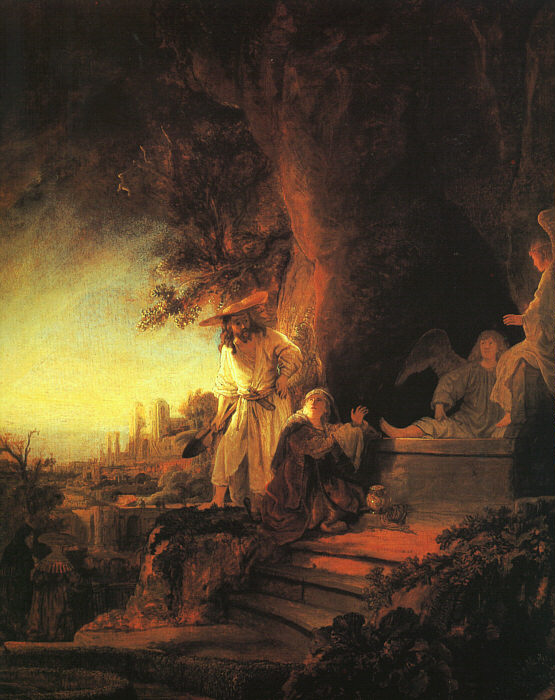
Rembrandt, "The Risen Christ Appears to the Magdalen"

The Kingdom of God is not a wsiwyg ("What you see is what you get") operation. The size of the seed does not determine the degree of impact on the garden. How does a seed become a plant anyway? Talk about a mystery of natural selection! For that matter, how does a simple commitment of the will to acknowledge Jesus as Savior and Lord lead to transformed individuals who when they band together, even in groups as small as 12, can turn the world upside down?

Yet I've seen this dynamic at work over and over again in ministry. You think you are making no impact. You think the people you are trying to reach are absolute buffoons. You start to think you yourself must be the biggest buffoon. But then something surprising happens. The guy you discipled who couldn't stay awake goes on to impact many other students before becoming a PHD in church history. The young woman who faded away from your housechurch comes back one day and says, "I left, but I got so depressed that I realized if I didn't go back, I was going to die, and I'm never leaving again." The national leader who betrayed you comes back in tears saying, "Now I understand. What I did was terribly wrong. Would you please forgive me?"

It doesn't all make sense when you first hear it, but get some private time with Jesus and he may just explain everything.

Friday, June 09, 2006

cultivating a legacy (Psalm 92)

So if one wants to cultivate a legacy how best to go about it? Psalm 92 provides several helpful steps.

A first step in cultivating a legacy is to enjoy a rhythm of celebration (vv. 1-4). This entire Psalm is meant to be used for this purpose. Make the Lord's day special by creating space for worship, especially through music. Play your guitar or piano. Put on something special on the stereo and take time just to listen. Get to church ten minutes early and soak up the prelude for all you can. Martin Luther said that “music is the language of the soul.” Let your soul sing and thrive. Think too not only about a weekly rhythm, but a daily rhythm as well. What better way to begin and end each day than with God’s own heartbeat?

A second step toward cultivating a legacy is to draw upon the power of the Spirit (vv 5-10). This is the power that does miracles even today (if we’ll only allow ourselves to enter into circumstances in which we need them). This is the power that leads to deep insight into the reality of the created order and God’s purpose for it. Such insight provides perspective on why the wicked seem to flourish for the moment, but will soon meet the fate of summer’s weeds. This is the power that strengthens and refreshes us as though we had the energy of wild bulls (the NLT does a better job than the NIV here). This is the power that brings down the wickedness of those who oppose the kingdom of God.

A third step toward cultivating a legacy is to plant oneself firmly within the house of God (vv. 11-15). At present, this means being personally invested in a local community of faith that anticipates the heavenly community that we’ll one day enjoy in full measure. Only here will our roots find the soil necessary to provide the strength we need to stand against the storms of life that will inevitably come.

May we as the people of God remain vital and green, produce fruit even in old age, and be able to declare, "The Lord is just. He is my rock. There is nothing but goodness in him!"

Thursday, June 08, 2006

legacy and futility (Ezekiel 31)

The Season After Pentecost
Year B, Proper 6

There is something awe-inspiring about Lebanon Cedars. The massive lower trunk provides a foundation for multiple massive limbs reaching for the sky, where they blossom out in crests of foliage that tower over any other foliage beneath. The cedar pictured here is part of a guesthouse estate in New Zealand (http://www.paheke.co.nz). It might be worth a visit. These Cedars can reach 70 feet tall and 30 feet in spread at the top. That's a lot of shade!

It's easy to understand why the prophet Ezekiel would use this tree as a metaphor for both the Assyrian and Egyptian empires. Who would have thought at the height of the Pharaohs' power that anything could happen to Egypt, even despite what had happened to Assyria? Who would think today about anything happening to the United States of America despite what happened to the Former Soviet Union?

If even Pharaohs and Presidents can be cut down in a day then is the best an individual or culture can hope for eventual futility? There is one individual and one culture that have yet to be cut down. This individual is the Son of God and this culture is his kingdom.

As the church, the ambassador of the kingdom of God, we need to sink our roots deep not into the constructs of any earthly kingdom, even a democratic one, but rather into the gospel, which is in actual fact good news for every tribe, tongue, and nation on the earth. The West itself may fall but the church will endure, as it always has.

The Clash of Civilizations will one day resolve for all under the shade of a tree even greater than the Cedar of Lebanon. "Then the angel showed me the river of the water of life, as clear as crystal, flowing from the throne of God and of the Lamb down the middle of the great street of the city. On each side of the river stood the tree of life, bearing twelve crops of fruit, yielding its fruit every month. And the leaves of the of tree are for the healing of the nations. No longer will there be any curse" (Rev. 22:1-2).

Will our lives and our churches leave a legacy, or only futility? It depends on where we presently take our shade. As citizens, we need to watch our political leaders carefully to make sure that they are pursuing justice rather than realpolitik. As believers, we need to appreciate the benefits of our respective cultures while also understanding where and how each of these cultures is still in need of the healing leaves of the Tree of Life. This requires much wisdom, discernment, discipline, and most importantly, prayer.

Wednesday, June 07, 2006

living by the Spirit (Rom. 8:12-17)

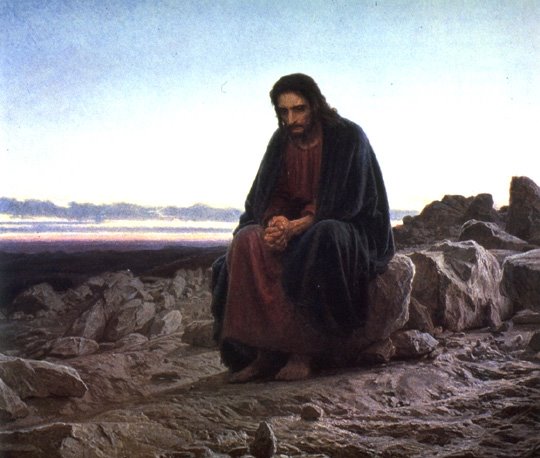
Kramskoy, "Christ in the Desert"
1872. Oil on canvas. The Tretyakov Gallery, Moscow, Russia

This final passage for Trinity Sunday reveals how we are to live once the Spirit of God has come into our lives.

The context is extremely important as it always is. As one of my mentors, Stuart Briscoe, puts it, "A text without a context is a pretext." He has another variation as well: "A text taken out of its context leaves behind a con." The context here is the emotional crisis of chapter 7 in which Paul writes, "Wretched man that I am." Then comes the glorious resolution of Romans 8:1: "Therefore, there is now no condemnation for those who are in Christ Jesus..." NO CONDEMNATION! Man, that's good news for me... :-)

Verses 12-17 build on this theme. We have a sinful nature (the flesh) as well as the Spirit. We have a responsibility to say "yes" to the Spirit but "no" to the flesh. Who are God's true children? Those who never sin? No, but rather those who are in the process of learning to say "no" to sin. Look inside your own soul: is there something there crying out "Abba (Daddy) Father"? This is the Spirit testifying with your spirit that you are a child of God. Now, if we are children, then here is more great news - we are heirs as well. The Hilton sisters have nothing on the children of Heaven.

Now comes the kicker. "... If indeed we share in his sufferings in order that we may also share in his glory." Just as Jesus put his earthly frame to death on the cross so we need to put our earthly frames to death in how we live. Just as his path to glory was marked with suffering, so may ours be. This suffering is not unbearable, nor is it an indication that God has left us. Rather, it is an indication that we are journeying into glory with him. What a joyous and victorious way to live!

Tuesday, June 06, 2006

the kingdom of God (John 3:1-16)


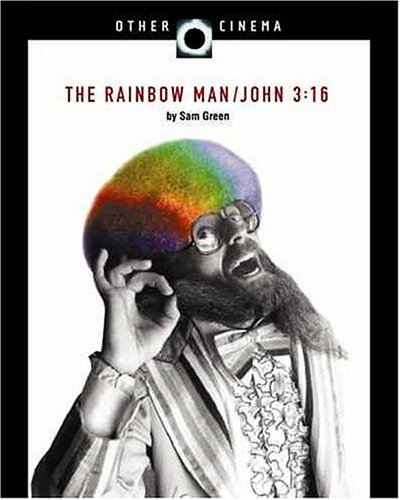
John 3:1-16 must be one of the most well-known passages in all of Scripture. This chapter is often thought of as "the born-again chapter". From the standpoint of popular American chapter, chapter 3 is the Jimmy Carter chapter, and John 3:16 is the Superbowl verse (a.k.a. the rainbow head guy verse). The danger with cursory familiarity is to miss the significance of what is actually being proclaimed.

The Apostle John, Jesus' best friend, was a great writer. There are several profound thoughts that he offers to us in this chapter.

A first profound thought John offers is that the gospel is all about the kingdom of God. In response to Nicodemus's opening question Jesus says, "No one can see the kingdom of God unless he is born again." Note that the ultimate concern here is not being born again: it is seeing the kingdom of God. Being born again is the means to the end but not the end in itself. Being born again is the necessary entry into the kingdom, but the implications of the kingdom then extend far and wide in every direction. What then is the kingdom of God? God's rule in God's place. This is what the people of God are to be bringing into reality in our places of employment, in our homes, and in our friendships.

A second profound thought John offers is that entering the kingdom of God starts with spiritual regeneration. This spiritual regeneration is nothing less than spiritual rebirth affected by the Spirit of God coming into our very souls. Ever since Eve at the apple in the garden of Eden, and Adam joined her, human beings have been born degenerate. The only hope we've had is an act of God, which is what would soon happen at Pentecost after Jesus' crucifixion. The Spirit would come and take up residence in the hearts of those who called out for mercy and help. This same Spirit comes today upon anyone willing to say, "Lord Jesus, have mercy on me, a sinner."

A third profound thought John offers is that living out the kingdom of God involves a very public commitment. As a writer, John was a lover of subtelty. In this case, note when Nicodemus came to Jesus - at night (v. 2). Jesus picks up on the theme of light and darkness later in this interaction in v. 19: "Light has come into the world, but men loved darkness instead of light because their deeds were evil." Nicodemus came to Jesus at night, but would he acknowledge Jesus in the broad light of day? Fast forward to just after Jesus' crucifixion. Joseph of Arimathea asks for the body of Jesus (John 19:38), and who was with him? None other than Nicodemus, "the man who earlier had visited Jesus at night." Not only did Nicodemus step up to acknowledge Jesus in public, but he brought with him 75 pounds of spices. As a member of the Jewish ruling council, this could not have won Nicodemus any points at the Pharisees' country club. The implicit challenge to us is this: are we willing to make a public commitment to bring the kingdom of God into being? If so, ask yourself, "What will I do about this today?"

Monday, June 05, 2006

encountering God (Exodus 3:1-6)


Mount Horeb (a.k.a. Mount Sinai) was the very place from which Moses would later receive the Ten Commandments. If Monty Python is correct, there were originally 15 commandments on 3 tablets, but Moses dropped one, leaving 10. Humor notwithstanding, there are at least three truths about God revealed in this passage.

The first truth is that God is historical. He is the God of Abraham, Isaac, Jacob, Moses, as well as of us. We can see his purpose unfolding through history, which can give us tremendous confidence in its veracity as well as our destiny.

The second truth is that God is personal. He revealed himself to Moses in the form of flames in a bush that did not burn up. While the text indicates that this was an appearance of the angel of the Lord, apparently all Moses could see were the flames. Otherwise, instead of saying, "I think I'll go check out why this bush isn't burning up," he would more likely have said, "Hey, there's an angel standing in that bush!" In any case, we ought to be open to personal encounters with God of our own, and we ought to remember that God himself is personal, albeit three persons in one.

The third truth is that God is holy. On this side of the cross, every place where we place our feet is holy ground being reclaimed for the kingdom of God. Being conscious of this will transform our character, our marriages, our families, our workplaces, and even our churches.

For the curious, an extensive discussion of the possible location of Mount Horeb (Sinai):
http://fontes.lstc.edu/~rklein/Documents/MountSinai-Horeb-Timah.htm.
The argumentation here relies partially on some garbling in the biblical narrative. Evangelicals may find this troubling, but is important for us to maintain open minds. If the truth is on our side we have nothing to fear. I don't presently have an opinion on this argumentation. See Barry Beitzel, Moody Atlas of Biblical Lands, for a reasoned survey of the large volume of scholarship available on the location of Horeb / Sinai from an evangelical perspective. His opinion is that Mt. Horeb was in the southern Sinai (the eastern portion of modern day Egypt). Another good resource is "Sinai, Mount", The New Bible Dictionary, Marshall, Millard, Packe

Sunday, June 04, 2006

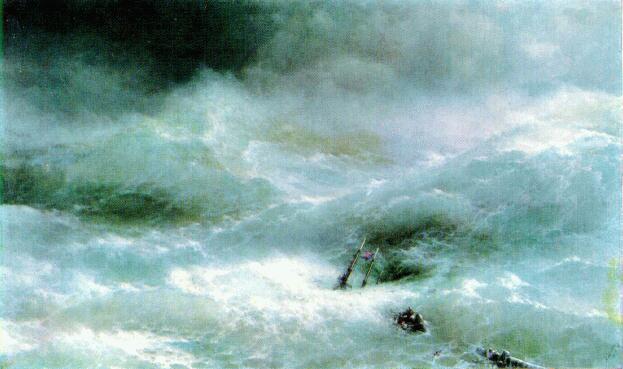
the power of the waves (Psalm 93)


Aivazovsky, Ivan (1817-1890), "Wave".
Oil on canvas. Original: 304 x 505 cm, The State Russian Museum.

Francis Schaeffer once remarked that modern man is in despair because he has both feet planted firmly in mid-air. What a contrast we see in Psalm 93.

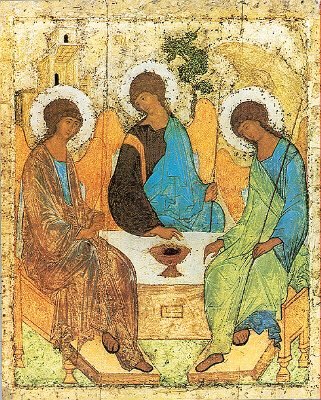
Here Jehovah stands firmly with one foot planted on his majesty and the other planted on his strength. Remember the purple and blue of the central figure of Rublev's Holy Trinity icon? The world is "firmly established" because the Lord's integrity holds it together. In this truth is great peace and hope for us: despite the fallenness of this world, the Lord's created order remains, and will ultimately prevail.

We all marvel at the power of breaking waves. The Asian tsunami and flooding of New Orleans were grim reminders of just how powerful the force of water can be. Yet as powerful as this force is, "mightier than the thunder of the great waters" is the Lord on high.

His "royal decrees" (v. 5, NLT) stand firm. We can choose to live by them or against them. We can thereby choose to stand against anything that crashes in on us, or choose to be crushed by the overwhelming strength of Jehovah's character and purpose.

Trinity Sunday


The Holy Trinity icon by famous Russian Orthodox iconographer Andrei Rublev (1360 - 1430) is a powerful invitation to reflection on the truth of the Holy Trinity. Last Sunday we celebrated the coming of the Holy Spirit, the third member of the Trinity, at Pentecost. On Sunday June 11th we celebrate Father, Son, and Holy Spirit worshipping together in the community of what is true, good, and beautiful.

Note first the three chalice shapes in this image. First, there is the chalice itself. Second, there is the table as chalice. Third, there are the three members of the Trinity themselves, offering to us in the shape of an existential chalice God's redemptive purpose for each of our lives and for the world as a whole. All of life is meant to be holy, and can be!

The colors which infuse this icon are also significant. The gold which frames the image symbolizes divine energy. The purple of the central figure symbolizes the majesty of divine love. The blue which each member has in different proportion symbolizes hope, and the green which adorns the figure on the right symbolizes life.

There is debate over which figures represent which members of the Trinity. It may be that the central figure is the Father, and that as he looks at the Son on our left, his two fingers symbolize the divine and human natures of His Son. The Son in turn blesses the Father's purpose with his own palm facing the Father. The Spirit, on our right, holds the same staff of authority of the others, and points to the rectangular opening on the front face of the altar to indicate that the divine sacrifice is intended to reconcile the whole world back to the Father.

Truth, beauty, and goodness seem to be commodities in short supply in the modern world. Yet the divine energy that infuses this image actually infuses each one of our live, which means today can be the day of transformation and victory. The Holy Trinity is not a theological construct to be ignored, but rather the originating source of the authentic individualism and authentic community for which we all long in the depths of our souls. Let us be the people of God today for the glory of the Father, Son, and Spirit.

Why I'm doing this

I have a great love for the church and for seeing her fulfill her mission in the world. I also have a love for the Revised Common Lectionary as a means of reading the Bible in community with other believers from around the world.

My hope is that some of my reflections might refresh busy and tired pastors and ministers and also encourage lay people to take up and read.

Karl Barth apparently said his approach to devotional reading was to read with the Bible in one hand and a newspaper in the other. This is when things can get exciting.