Reflecting on the Revised Common Lectionary to live out the gospel in all of life
Saturday, July 29, 2006
new selves breaking forth (eph 4:17-25)
This passage has an important point to make for both unbelievers and believers respectively.
Regarding unbelievers, the author, the Apostle Paul, makes clear that their thinking is, well . . . , a little bit . . . well, actually quite a bit . . . off. Unbelievers live in “the futility of their thinking.” Paul goes so far as to claim that unbelievers are dullards who have given themselves completely to a sensuality characterized by indulgence, impurity, and lust. Isn’t this a bit extreme? Answer: Michael Jackson, Lifestyles of the Rich and Famous, Playboy, Madonna, Prince, Entertainment Tonight . . . I find such language bracingly refreshing.
Regarding believers, Paul notes that we have new selves that are breaking forth from within the husks of our old selves. These new selves were created so that we could “be like God in true righteousness and holiness.” Paul then makes the implication explicit: “Therefore each of you must put off falsehood and speak truthfully to his neighbor.”
The Greek word translated “falsehood” here is pseudos, which is often used with reference to religious falsehood. The Greek word used here for “neighbor” is plasion, which often carries the connotation of “fellow believer” versus merely “neighbor”. Putting these two observations together, one way to put this into our vernacular might be to say, “Don’t fake it in church.” What if our churches were safe and intimate places where we could honestly wrestle with the husks of our old selves while encouraging one another to put on our new selves in a manner “worthy of the calling we have received” (Eph. 4:1)?
Here is a simple way you can help make it happen. Find two other believers with whom you can start what is called a “Life Transformation Group”. For more information, see the references to Neil Cole and Life Transformation Groups here: http://www.organicchurchplanting.org/resources/allproducts.asp
Thursday, July 27, 2006
Bread from Heaven (John 6:24-35)
The Miracle of the Loaves and Fishes, ca. 1545–50 Francis L. Leland Fund, 1913 (13.75)
There is great humor in this passage. For example, Jesus has just fed 5,000 people with five loaves and two fish. Then he crossed a lake without a boat. What is the crowd’s response? “What miraculous sign will you show us?” Jesus could justifiably have responded, “Well… how about the loaves and fish routine immediately followed by walking on water trick?” Then there is the whole bit about, “How can he say he came down from heaven. Hah! We know his parents.”
The point our author John is making here is that the evidence was not the issue. Rather, the issue was and continues to be unbelief. Jesus had already demonstrated himself to be the Son of God. He would do so again and in a manner without precedent at his resurrection.
There is nothing more demonstrative God can do even today to reveal Jesus as Messiah and Savior. Thus the work of the believer consists of only one simple act: to believe this. All of life then flows from this belief in grace and peace.
Do you believe that Jesus is the bread of life? In other words, do you believe that he is the vital sustenance you need to live, and to live abundantly? John 6 is his body broken for you and his blood shed for you. It is finished. The Lord’s Supper points us to John 6, which in turn points us to Jesus. Rest and rejoice.
Rebelliousness quelled (Psalm 78)
One cannot overstate the difficulty of God’s management challenge. One would think that after a series of miracles and a miraculous deliverance from Egypt that his people would have been forever changed. Not so . . . not even those events could root out of them the stubborn and rebellious inclinations that continued to lead them astray. One would think that having forgotten all of that once, and then having God do another series of miracles in the desert that the message might get through. Not so. Well… certainly third times a charm. His people enter the Promised Land. Nope… Well . . . okay, how about the perfect leader in King David. Strike four. What does a god have to do with people like this?!!! Jesus . . .
Why the desert? (Exodus 16:2-15)
Proper 13When God delivered his people out of Egypt he didn’t deliver them directly into the Promised Land. There was a desert in between. Why? He could have translated them directly to their new land. He could have made the deserts green along the way. Why subject them to that miserable desert?
There may be multiple reasons for the desert. One might be to allow God’s people to prepare for life in a land of abundance. A second might be to help God’s people appreciate the significance of blessing when it comes. A third might be for the Lord to demonstrate His power to provide.
I know a man who works in a vocational desert. He isn’t currently working within his passion, and has to put up with things from which his past leadership experience could reasonably be expected to exempt him, yet he’s doing what is necessary for this particular chapter of his life to provide for and nurture his family. The desert brings with it blessings that only the eyes of faith can see.
Do you find yourself in the midst of a desert? . . . Maybe vocational, marital, physical, emotional, or spiritual. How might the Lord want to use this to prepare you? To help you appreciate? To demonstrate to you His power? You too might have days when you long to return to the slavery of Egypt but God isn’t going to let you settle for so little. Trust him and journey on in grace and peace.
Saturday, July 22, 2006
meditation for the materialist (Psalm 14)
Is there really no evidence for God's existence? Granted, in a scary world the concept of a deity would be a comforting concept, and granted, this comfort could then have been exploited by others to secure their own accumulation of power and wealth. All of this is possible, but is it plausible? Consider the evidence as presented in this Psalm.
One line of evidence for consideration is the corruption of humanity. Why is it that human beings are capable of such vile things? Why is it that no one lives completely by the standards of what is right that they know innately within? The Bible’s explanation for the problem is something called sin, which is the idea that humanity has rebelled against God and thereby become corrupt.
A second line of evidence for consideration is the persistence of righteousness in the world. Given the vile things humanity is capable of why does any righteousness exist? This Psalm says it exists because of "God's company in the presence of the righteous". Sometimes, even in this cruel world, the poor do find refuge, and this is a righteous thing.
A final line of evidence for consideration is the historical claim of the resurrection. The author of this Psalm looked forward to a day when “salvation for Israel would come out of Zion.” In a literal sense Zion denotes one of the hills in the city of Jerusalem. Yet 'Zion' was often used in the Old Testament to refer to the entire city of Jerusalem, or even the entire nation of Israel. In this Psalm the most natural of these possible meanings is the second: “oh that salvation for Israel would come out of Jerusalem.” This is precisely what happened when Jesus rose from the grave after being crucified on the cross. This is a historically verifiable claim that can be evaluated with commonly accepted standards for historicity.
So much for the part about where salvation came from. Who was it for? Israel. But what then does the author mean by ‘Isrsael’? Consider these verses from Hebrews chapter 12:
22 But you have come to Mount Zion, to the heavenly Jerusalem, the city of the living God. You have come to thousands upon thousands of angels in joyful assembly, 23 to the church of the firstborn, whose names are written in heaven. You have come to God, the judge of all men, to the spirits of righteous men made perfect, 24 to Jesus the mediator of a new covenant, and to the sprinkled blood that speaks a better word than the blood of Abel.
The blood of Abel speaks condemnation while the blood of Christ speaks reconciliation. And here Mount Zion, the heavenly Jerusalem, and the church are all seen as one and the same. What a special place and assembly we have in this thing called church.
Wednesday, July 19, 2006
want some more of that (2 Kings 2:1-15)

Proper 12
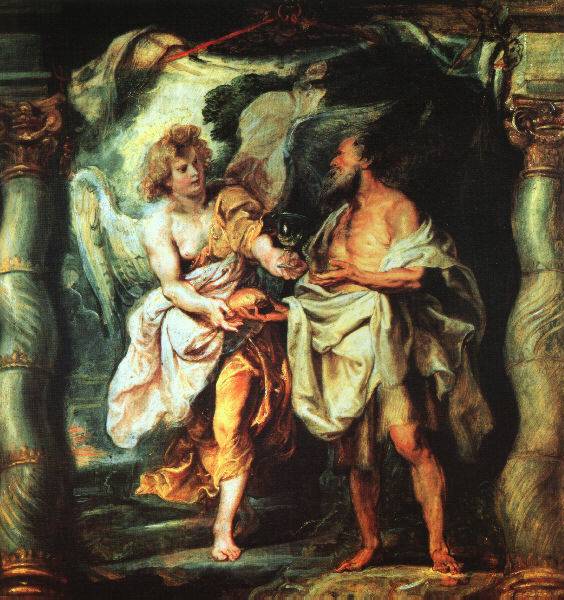
"What can I do for you?" asks Elijah of Elisha. "Give me a double portion of your spirit." Have you ever met someone full of enthusiasm? This word derives from two Greek words: EN and THEOS, which mean together "God is in it." Elijah strikes me as a "God is in it" kind of guy. His love for the Lord was infectious. People like this are far too rare.
I had (and still have) one such friend named Tom. In college, he got the crazy idea that we ought to get up at 2:00 am every night to pray for the guys on our respective dorm floors. Wierd, right? We did it. Nothing happened... at first. But then there was the Jericho walk around the dorm with about 20 people praying for God to give us the dorm, a trumpet and trombone blaring. Not much more happened... that year. The next year, a large number of people from that dormitory found their way into the kingdom of God. Thank you, Father, for Tom, for his genuine enthusiasm for you, and most of all, for his friendship. I want some more of that!
Point to ponder: Who would want a double portion of the spirit of a guy prone to depression? This is the very place where the angel of God met him (1 Kings 19). From whence does enthusiasm ultimately spring?
Sunday, July 16, 2006
Jews, Gentiles, and Arabs (Eph. 2:11-22)
I saw on Drudge this morning that Newt Gingrich is calling for President Bush to admit that we're already in World War III. Maybe he knows about massive troop movements that I don't, but short of that, this sounds premature, albeit not out of the realm of near-term possibility. Amidst the present conflicts and risks, it is important to remember that there is hope for us all in ... I'm hesitant to bring this up again so soon after my recent post ... the blood of Christ. (Hey, I didn't pick the passage, okay?). "Remember that you were excluded from citizenship in Israel . . . but now you who once were far away have been brought near through the blood of Christ. For He Himself is our peace."
I long for peace for both Arabs and Israelis in the Middle East. Hopefully a mutual understanding can be re-established. Yet regardless, remember that Christ has died to put an end to the most deep-seated of conflicts, and our Heavenly Father is committed to an outcome in which every tribe, tongue and nation will have its place of redemption before his throne.
Note too what 'Israel' has come to mean for Paul in this passage. "Consequently, you are no longer foreigners and aliens, but fellow citizens in God's household . . . to become a holy temple in the Lord." Paul is not talking here about Christians emigrating to 21st century Israel to become a human pyramid on Temple Mount. He is talking about a deeper fulfillment of what 'Israel' actually means. Some denigrate this as "replacement" theology, but the issue is actually progressive fulfillment. We must be able to read all of Scripture into context, and appreciate both the continuities and discontinuities from old covenant to new. When we do so, and come to realize that the church is actually central to God's redemptive-historical plan, we no longer need to confine our hope to the EU, United Nations, or even the United States of America.
I hope that in the way we Christians communicate, relate, and engage politically, that we will advocate for a place at God's table for every people, including Jews, Gentiles, and Arabs.
I would agree with Newt to this extent: we are at a greater risk of nuclear war than at any time in the history of the world. Father, deliver us all from evil. May voices of reason and moderation be in the ascendant on all sides.
Saturday, July 15, 2006
(comments welcomed)
give them what you have (Mark 6:30-44)
Who's your brother? (Psalm 22:22-31)
In bringing many sons to glory, it was fitting that God, for whom and through whom everything exists, should make the author of their salvation perfect through suffering. Both the one who makes men holy and those who are made holy are of the same family. So Jesus is not ashamed to call them brothers. He says, "I will declare your name to my brothers; in the presence of the congregation I will sing your praises." (Heb 2:10-12)
One question you might ask right away: “Wait a minute! How are we supposed to know that Psalm 22 refers to Jesus? … A reasonable question. The most natural interpretation in reading the Psalm itself is that the brothers are the Psalmists family, friends, and local congregation. The answer one commentary gives is that the early church regarded Psalm 22 as Messianic, and therefore it was natural for the author to the Hebrews to understand Messiah to be the speaker in that Psalm.
Okay, but why did the early church regard this Psalm as Messianic? Were they just making this up as they went along?! No. The early church regarded this Psalm as Messianic at least in part because Jesus himself recited this Psalm's opening words when he died. This led the early church to explore a number of other Messianic themes found throughout the Psalm. For more information see http://www.crossmarks.com/dissertation/abstract.htm.
Whose your brother? None other than Jesus, Messiah, Son of God. Who better to understand the real you than your own brother? Enjoy some time today with a most distinguished sibling who thinks the world of you.
Wednesday, July 12, 2006
For the crushed and broken (Isaiah 57:14b - 21)
Proper 11 (Year B)
The passage begins with our Heavenly Father saying, “Build me an interstate, because I want to get my people back to me, en masse, without delay.” He then says, “I live in a high and lofty place, but not only there. I also live with the contrite and lowly.” 'Contrite and lowly' can also be rendered “crushed and bowed down.” Where you are crushed and bowed down your Heavenly Father is right there with you.
One thing that can crush us is the persistent power of sin. Why do I keep doing that?! We get discouraged and eventually numb. Can I ever really change? Yes, because God is committed to changing me. Our Father says, “I have seen his ways but I will heal him.” Jacob, whose name meant “deceiver”, was renamed Israel, or “wrestler with God”. That's putting a more positive spin on the matter... Jacob was not saved because of his own merit, even in making a good decision. He was saved because of his Father’s determination to bless him. So Isaiah says here, it will be with us. "I have seen his ways but I will heal him."
What does this mean for us? “I will guide him, restore comfort to him, and heal him.” This is an invitation to walk the healing path of grace today in confidence. Can you do this? I see that glimmer in your eye...
Tuesday, July 11, 2006
predestined for glory (Eph. 1:3-14)
Title page of 1560 Geneva Bible
How interesting that Paul opens his letter to one of his favorite churches, the one at Ephesus, with the topic of predestination. Granted, Paul himself had spent three years teaching there, so maybe this was a mature group of believers ready for meatier material. Would our churches today lead with this topic after three years, much less after thirty?
What does this passage actually say about predestination? . . . That we were chosen before the creation of the world; that we have been adopted according to his good pleasure and will; and that all of this is freely given by a gracious God. As it was with Abraham so it was with Ephesus: God says, “I will surely bless you.” There are many who would harmonize predestination with free will by suggesting that predestination is merely divine foreknowledge of our own choices. This passage appears to be problematic for this line of interpretation. There are many places where the Bible calls upon the freedom of our wills, and this must be factored into the overall theological equation, but this passage is not one of those places.
What is here is the Apostle Paul saying, “Look, this is who you are.” Paul actually continues this way three chapters before getting to his first action item at the beginning of chapter 4: I urge you to live a life worthy of the calling you have received. One of Paul’s cardinal rules of preaching is this: respond to the imperative in light of the indicative. In other words, teach them who they are before you tell them what to do. This is good advice for preachers that is too rarely followed.
We are predestined for glory. May we together today move toward whom we are meant to become.
Saturday, July 08, 2006
a sense of mission (Mark 6:7-12)
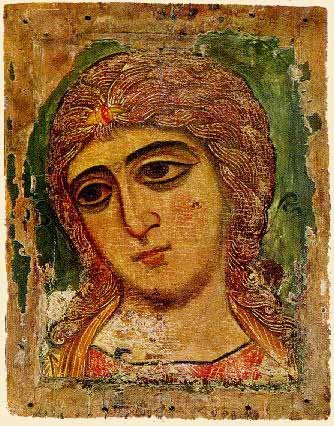
The Archangel Gabriel
Jesus' own ministry teaches us several important principles about ministry. The first principle is that ministry requires engagement. Jesus went around teaching from village to village. He didn't just simply put out his single and wait for people to come to him. What if more churches did this today. My own home church Elmbrook is currently hosting a series of discussions at the local Barnes and Noble bookstore on the Da Vinci Code. Kudos, and how much better than a boycott.
The second principle is that ministry is leveraged through personal discipleship. Jesus did a lot of personal ministry to many people yet everything hinged on whether twelve men got the picture. Is there really any better strategy today? If not, who are your twelve?
The third principle is to travel light. We Americans get so weighed down with our junk that we get immobilized. The Russians with whom I used to minister travelled with nothing more than a Bible, a toothbrush, and the clothes on their back. I started to do this with them (well.. okay, I often brought my laptop as well) and absolutely loved it. On overnight trips I had to take a shower before my family would receive me, but I loved it. You could try it too. Just limit yourself to one bag with a few essentials, get out there, and see what happens.
There are other great principles in this passage as well:
- Ministry is often done best in pairs
- Remember that opposition comes with the job (done well)
- Shake it off
- The response we're looking for is repentance
- The gospel is about power and healing (that's different than health and wealth)
moral clarity (psalm 24)
But whose hands are really clean and whose heart is really pure? Those who have been cleansed and purified by the blood of Jesus shed on the cross of Calvary. “For God was to have all his fullness dwell in him, and through him to reconcile to himself all things, whether things on earth or things in heaven, by making peace through his blood, shed on the cross” (Col. 1:20).
Once, in a liberal theological setting, having mentioned the blood of the cross in reference to a passage referring to it, I was told, “We don’t talk about that here.” The problem was that ‘blood’ was associated with “fundamentalist”. At the time, I was so taken aback, I didn’t know how to respond. With the benefit of reflection, my response now is, “Maybe it would be better to change the association than to avoid the concept.”
Amos’s plumb line is anchored by the cross. Bow your knee to it today that you may receive anew clean hands and a pure heart, for here you will find the “blessing from the Lord” and “vindication” that you desire so desperately.
Then, look around you. Everything you see belongs to the Lord. Redeem all of it accordingly.
Thursday, July 06, 2006
plumbing one's soul (Amos 7:7-15)
Proper 10
At the time Amos was writing the two kingdoms of Israel were prospering on the outside but rotting from within. Amidst increasing prosperity there was a lack of social concern; the rich were getting richer and the poor were getting poorer. Fidelity was giving way to the borrowings of syncretistic style. Yet none of this would have been noticeable without the plumbline of God's holiness as an objective reference.
When is the last time we've plumbed our own souls? Am I living so as to bring God glory or merely to please myself? Am I investing my time, talents, and resources wisely or foolishly? Am I building a legacy or lost in confusion?
Amaziah, the presiding religious authority for Israel (the northern kingdom), responded to Amos by saying, "Go and do your preaching somewhere else." This is a typical response when truth cannot be denied. Amaziah and Israel would have done better to listen and repent. They didn't and they are no longer with us.
What about you?